Showing posts with label wikipedia. Show all posts

Sunday, January 27, 2013

Shakesperience, ADEs on iTunes U, the Public Domain, and More


Deep Learning vs. Surface Learning: Getting Students to Understand the Difference
Most teachers . . . recognize that test formats directly affect the choice of study strategies. We are committed to preparing questions that require higher level thinking skills. Our students discover they can't answer those questions with the easy information bits they've memorized and so they start studying differently. The problem is that without teacher guidance, students end up selecting deep learning strategies more by accident and less by design. 

Creating A Culture Of Innovation
This iTunes U course provides a wealth of interviews and instructional materials that can help teachers create a culture of change. Designed for K-20 educators, the assets guide the user through self-directed professional development. Work through each asset one at a time to create your class website, author a multi-touch book, develop a visual mission statement for your classroom or school district, use videoconferencing to bring outside experts into your class, and much more.

iBooks Author Goes Beyond Textbooks
Link to USA Today http://tinyurl.com/dyz8jp9
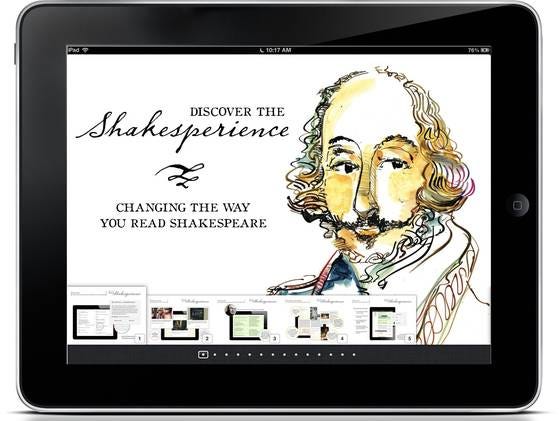
Raccah said she’s focused on . .  producing “an experience or solving a problem,” not just adding “bells and whistles” to backlist print titles. That’s what drove the creation of the Shakesperience, a series of enhanced e-books created with iBooks Author that use multimedia content to transform how students as well as theater professionals read, study, and learn about Shakespeare’s plays. 

Should Students Use Wikipedia?
Wikipedia is a tool, just like a lot of other things. It can be abused or it can be used for the good of mankind. Really, it isn’t much different than the information you would find in a textbook. Perhaps in the early days of Wikipedia, there was some unreliable stuff in there. However, I think that Wikipedia has matured enough that you won’t find too many seriously wrong things in there. You still find incorrect things in textbooks, so … not much different.

What Could Have Entered the Public Domain on January 1, 2012 . . .
Under the law that existed until 1978
Current US law extends copyright protection for 70 years after the date of the author’s death. (Corporate “works-for-hire” are copyrighted for 95 years after publication.) But prior to the 1976 Copyright Act (which became effective in 1978), the maximum copyright term was 56 years. . . .Under those laws, works published in 1955 would be passing into the public domain on January 1, 2012.

RSA Animate - Changing Education Paradigms
This animate was adapted from a talk given at the RSA by Sir Ken Robinson, world-renowned education and creativity expert and recipient of the RSA's Benjamin Franklin award.


Friday, October 23, 2009

Reflections on "Information Rich & Attention Poor"

Today's post centers on Peter Nicholson's Information-rich and Attention-poor (Toronto Globe and Mail). The samplings below provide a context for my reactions, but the entire piece is worthy of contemplative reading:

The three technologies that have powered the information revolution – computation, data transmission and data storage – have each increased in capability (and declined in cost per unit of capability) by about 10 million times since the early 1960s.

This has unleashed a torrential abundance of data and information. . . . .The primary consequence is the growing emphasis on speed at the expense of depth. This is simply because depth and nuance require time and attention to absorb.

There is also under way a shift of intellectual authority from producers of depth – the traditional “expert” – to the broader public. This is nowhere more tellingly illustrated than by Wikipedia, which has roughly 300,000 volunteer contributors every month.

The result is the growing disintermediation of experts and gatekeepers of virtually all kinds. The irony is that experts have been the source of most of the nuggets of knowledge that the crowd now draws upon in rather parasitic fashion – for example, news and political bloggers depend heavily on a relatively small number of sources of professional journalism, just as many Wikipedia articles assimilate prior scholarship.

. . . . Access[ing] efficiently what you need, when you need it. . . depends, of course, on building up a sufficient internalized structure of concepts to be able to link with the online store of knowledge. How to teach this is perhaps the greatest challenge and opportunity facing educators in the 21st century.

The hyperlinked and socially networked structure of the Internet may be making the metaphor of the Web as global “cyber-nervous system” into a reality – still primitive, but with potential for a far more integrated collective intelligence than we can imagine today.

Reactions:

*I think the article emphasizes to educators how poorly we are served by the notion that students are techno wizards and only need to be liberated by their keepers to roam the Net in order to optimize their futures and serve society. Instead, teaching them how to access, assess, and pool information is of paramount importance.

*Though Nicholson argues convincingly for the continued need for trained journalists and academic experts, it certainly calls into question the usefulness of traditional academic "departments" and anything that resembles the traditional newspaper.

The article reinforces my opinion that teaching technology in a vacuum is nearly as great a waste as requiring students to memorize information from textbooks-- information that is accessible with a few keystrokes. Both a liberal arts education and the ability to operate within the global network are absolutely essential....and I will have more to say about this in my next post!

This article came to me through my personal learning network. The recommendation and link came from two different sources. In the olden days (two years ago?) I would have depended on a newspaper or magazine to bring Nicholson to my attention, and then search for it in a library database (quite unlikely). I'll be running a staff in-service on pln's in a couple of weeks. More fuel for the fire.

----------------------------------
"Atrappée dans l'information #1" Flickr Creative Commons Photo by ton3vita

Blog Archive