Showing posts with label Sir Kenneth Robinson. Show all posts

Sunday, January 27, 2013

Shakesperience, ADEs on iTunes U, the Public Domain, and More


Deep Learning vs. Surface Learning: Getting Students to Understand the Difference
Most teachers . . . recognize that test formats directly affect the choice of study strategies. We are committed to preparing questions that require higher level thinking skills. Our students discover they can't answer those questions with the easy information bits they've memorized and so they start studying differently. The problem is that without teacher guidance, students end up selecting deep learning strategies more by accident and less by design. 

Creating A Culture Of Innovation
This iTunes U course provides a wealth of interviews and instructional materials that can help teachers create a culture of change. Designed for K-20 educators, the assets guide the user through self-directed professional development. Work through each asset one at a time to create your class website, author a multi-touch book, develop a visual mission statement for your classroom or school district, use videoconferencing to bring outside experts into your class, and much more.

iBooks Author Goes Beyond Textbooks
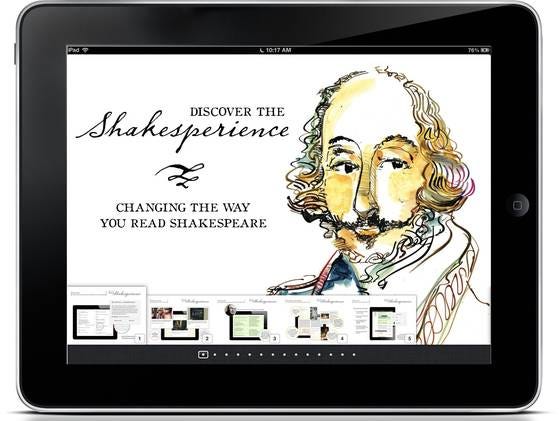
Link to USA Today http://tinyurl.com/dyz8jp9
Raccah said she’s focused on . .  producing “an experience or solving a problem,” not just adding “bells and whistles” to backlist print titles. That’s what drove the creation of the Shakesperience, a series of enhanced e-books created with iBooks Author that use multimedia content to transform how students as well as theater professionals read, study, and learn about Shakespeare’s plays. 

Should Students Use Wikipedia?
Wikipedia is a tool, just like a lot of other things. It can be abused or it can be used for the good of mankind. Really, it isn’t much different than the information you would find in a textbook. Perhaps in the early days of Wikipedia, there was some unreliable stuff in there. However, I think that Wikipedia has matured enough that you won’t find too many seriously wrong things in there. You still find incorrect things in textbooks, so … not much different.

What Could Have Entered the Public Domain on January 1, 2012 . . .
Under the law that existed until 1978
Current US law extends copyright protection for 70 years after the date of the author’s death. (Corporate “works-for-hire” are copyrighted for 95 years after publication.) But prior to the 1976 Copyright Act (which became effective in 1978), the maximum copyright term was 56 years. . . .Under those laws, works published in 1955 would be passing into the public domain on January 1, 2012.

RSA Animate - Changing Education Paradigms
This animate was adapted from a talk given at the RSA by Sir Ken Robinson, world-renowned education and creativity expert and recipient of the RSA's Benjamin Franklin award.


Monday, December 20, 2010

Talent,Friction, Smartboards, and other Matters

We make very poor use of our talents . . . .There are many possible explanations for it, and high among them is education. Because education, in a way, dislocates many people from their natural talents, and human resources are like natural resources-- They are often buried very deep. . . .You have to create the circumstances where they show themselves. And you might imagine that education is the way that happens, but too often it's not. . . Every education system in the word is being reformed at the moment. And it's not enough. Reform is no use, anymore. Because that's merely improving a broken model.

Sir Kenneth Robinson, Bring on the Learning Revolution, TED Talk.
-----------------

Many academics question industry-backed studies linking improved test scores to their products. And some go further. They argue that the most ubiquitous device-of-the-future, the smartboard -- essentially a giant interactive computer screen that is usurping blackboards in classrooms across America -- locks teachers into a 19th-century lecture style of instruction counter to the more collaborative small-group models that many reformers favor.

Stephanie McCrummen, " Some Educators Question. . . ." Washington Post

---------------------------------

The new media have caught on for a reason. Knowledge is increasing exponentially; human brainpower and waking hours are not. Fortunately, the Internet and information technologies are helping us manage, search and retrieve our collective intellectual output at different scales, from Twitter and previews to e-books and online encyclopedias. Far from making us stupid, these technologies are the only things that will keep us smart.


Steven Pinker, "Mind over Mass Media New York Times


---------------------------------
It's not good enough to ask your team to "be more creative" or to "tighten up the purse strings" . . . Inertia and decision paralysis will conspire to keep people doing things the old way. To spark movement in a new direction, you need to provide crystal clear guidance

Chip Heath and Dan Heath, Switch: How to Change Things When Change Is Hard


---------------------------------
"ken being smart on the smartboard" Flickr CC photo by 46137

Blog Archive